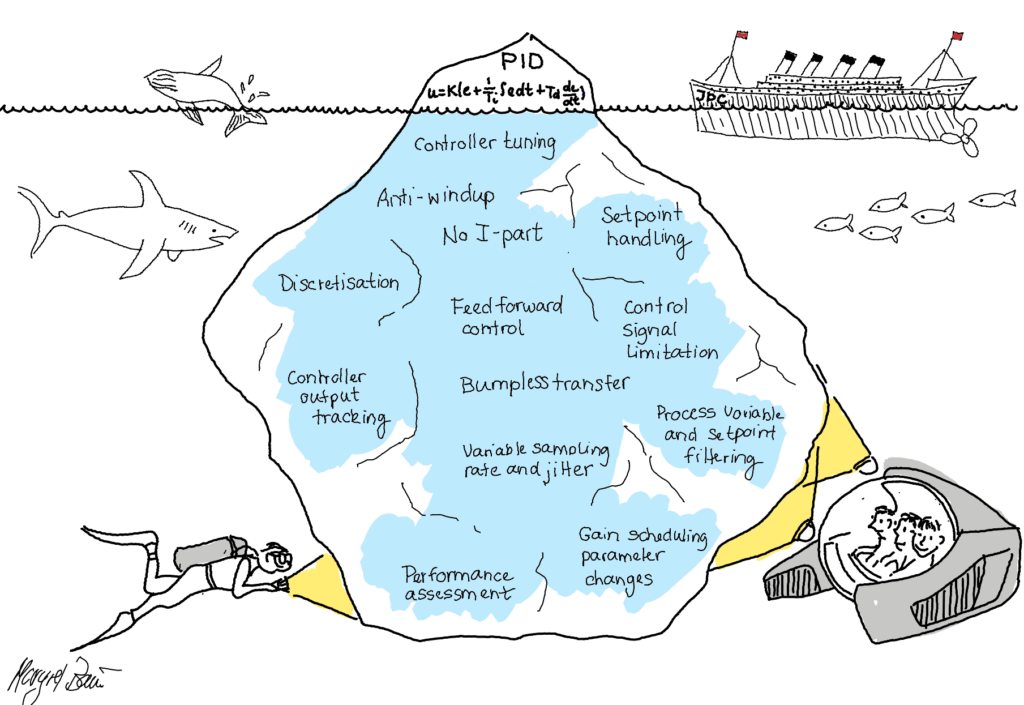
PID is the most widely used control law – not only in the process industry. Most control engineers are familiar with the standard equation of the PID (proportional-integral-derivative) control law.
Strangely enough, many (not all!) university researchers do not want to be associated with PID control because they consider it too trivial a problem and fear for their standing as an academic scholar. Others are simply not aware that there is a lot more work to be done (I’m listing topics below).
The International Federation of Automatic Control affiliated Journal of Process Control actively and specifically excludes work on PID control: “Advanced design methods exclude well established and widely studied traditional design techniques such as PID tuning and its many variants.”
This is wrong.
One would think that the implementation of a PID controller should be easy. It is not. And this has to be taught in the classroom and included in research activities.
– A real PID controller should be implemented as a difference equation.
– A real PID controller must consider the limitations of the actuator by including anti-windup, setpoint weights and rate limitations.
– A real PID controller should track the output when a second controller is active.
– A real PID controller should not result in bumps when switching from auto to manual.
– A real PID controller could work as a P-, PI-, PD- oder PID-controller.
– A real PID controller needs to support cascade, ratio, feedforward and other advanced control structures.
The list continues and none of the features is considered by the standard equation thought in most textbooks.