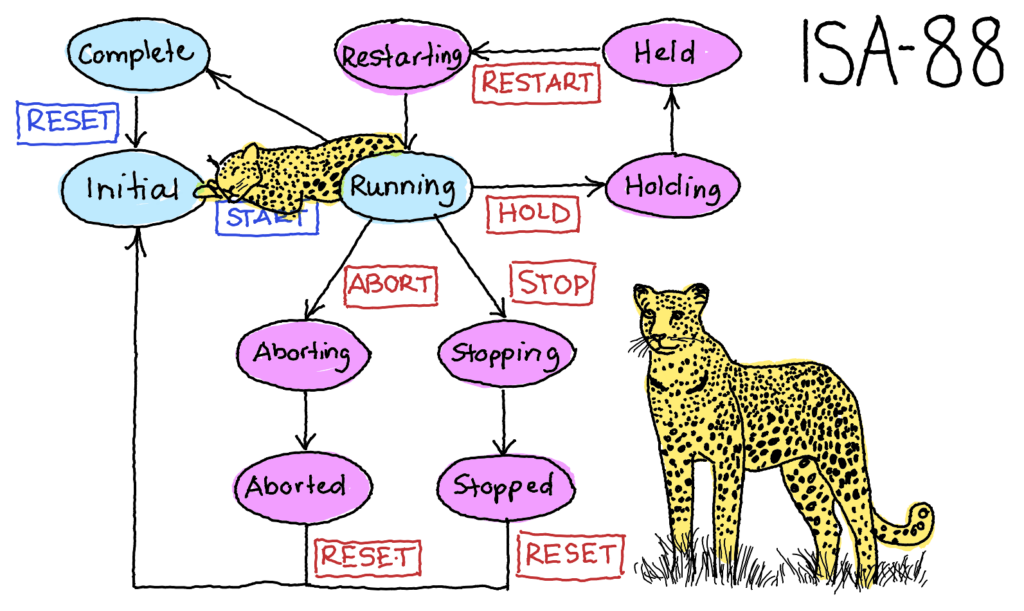
Every time I discuss the International Society of Automation (ISA) ISA-88 norm for batch processes with students, I think that it’s such a useful standard. At the same time, I feel the authors could have done one thing better: colouring in the bubbles. The square boxes are the actions available to the leopard operator. Blue is sleeping mode, orange covers normal procedures and pink often produces waste, abort being worse than just a stop. (Maybe colour was not available in 1988?)
In the context of autonomy: if the leopard could always snooze while producing, we’ve achieved full autonomy. There is a batch process at Covestro, managed and presented by Sabine Pegel at the NAMUR e.V. Annual Meeting in 2024, that runs autonomously.
In most processes, complete autonomy is not reached, because the process requires manual intervention (HOLD). (Embarrassingly, I used to think that ‘HOLD’ is for a toilet or coffee break.) Examples of ‘HOLD’ are something stuck in the process that must be physically removed. Or it means a sack of raw material must be added manually. Or the batch must be held a bit longer at a certain temperature because a quality variable has not been reached. Removing the cause of the hold (and stop and abort) interventions is the road to autonomy in batch processes: A very personal journey.
Autonomy may not always be desired, though. The operator must keep interacting with the process and product to react correctly in abnormal situations. A leopard that always sleeps is unlikely to know what to do when prey or a poacher comes along.